|
Tournament Director's Toolkit

Although I no longer actively coach, I am still very much involved in the running of tournaments. I have run tournaments of every shape and form for many years, both as director and in the tab room. In this toolkit I share my experience as best I can, providing a collection of documents offered as help for other folks running or thinking about running tournaments. Consider them as suggestions, aids for managing your tournament from start to finish. And please note that they are not intended to reflect the official procedures/rules of any organization: They are simply my thoughts, arranged as well as I could.
Latest update to the Toolkit: October 2026. Having done the complicated process of clearing a big waitlist, I thought I'd document it for the record.
Introduction
Registration
- Announcing Your Tournament
You need to get the word out to people that your tournament is going to happen. Here's how.
- Setting Tournament Deadlines
There are realistic ways of organizing the time between deciding to run a tournament and greeting people at the door on tournament day. Following these best practices assures the greatest happiness for the greatest number of people, including both you and your guests.
Part 1: Registration Opens
Part 2: Deleting TBAs
Part 3: Shutting Down
- Managing the Waitlist
If you're running a tournament that isn't open to all comers, no restrictions, then you need a waitlist. Here's the whys, the wherefores, and the how-to. It's not as easy as it looks, and there are best practices in place.
Addendum: A short note on Listing Entries.
Addendum #2: In 2026 I added this memo, explaining the process in excruciating detail when a major tournament has serious event caps, and the initial registration is roughly three times the size of those caps.
Running the Tournament
- Setting up registration tables at a tournament
The difference between a smooth registration process and a traffic jam is knowing how tabroom.com works, and how to use it to move people quickly out of the world and into your events. This pdf sums it all up. And consider this a strong recommendation: at high school tournaments, have an adult (maybe even the tournament director) run registration and, especially, collect the money and enter the amounts collected into the system.
Judge Management
- 5 Rules of Thumb for Judge Management
This is the basic strategy, however much you adhere to the specific tactics that follow.
- Judge expectations We ask a lot of judges at tournaments, and more than anything, we expect them to act as the educators in the room. But what does that mean? What, exactly, are the reasonable expectations for a judge at a high school forensics tournament? This is a general guide to the job that judges should be doing, including knowing the rules of their events, running their rounds professionally, and maintaining educational accountability and propriety. You can include whatever you want of this in your Live Doc, or maybe in an email to judges before the tournament, or in your opening remarks, if you have a starting assembly. I think that while it applies to all, it is especially important that younger judges get the message.
- How many judges do you really need to run a tournament?
Short answer: more than you'll ever get.
- Judge obligations/commitments for TDs
You can do it by-the-round or full-tournament. Which makes sense for you? I think we're pretty clear on it.
- Why MJP? Once upon a time, MJP (AKA MPJ) was very controversial. This document today is mostly only of historical value, documenting the era when MJP was just coming in. We're leaving it as part of the Toolkit just for the sake of nostalgia. (A version of this was originally published in Rostrum.)
- MJP in Practice If you're going to use MJP at your tournament, do it right. Including information on handling judges who never get to judge, and the use of strikes.
- One approach to tournament conflicts, for teams and for judges.
A conflict is a situation of too much love, not too little. This exhaustive list covers virtually all the situations. Distribute before every tournament, or at the very least include it in your Live Docs.
- Handling PF Judges Treat them right, and they're yours for life. Also, how to train them.
- A Brief Explanation of Judge Obligations for distribution to judges This is document you can distribute to judges, especially of the PF persuasion, who might be new to the activity. Among other things, it explains to them why they need to stay for the elimination rounds when their school is no longer debating. I recommend adding this link to your Live Docs.
- An introduction to PF for parent/new judges. This is a file you can distribute to anyone you'd like. It's probably used best for coaches training their own judges, but it can't hurt to include it in a Live Doc. You might use it in conjunction with the NSDA's original handout, which is still one of the best guides to the activity. (Note that the handout has the old prep times, but otherwise there's no problem with it.)
- How to handle the assignment of speaker points in debate. Following this advice could go far in at least getting new judges, e.g. PF parents, on the same page.
- And let us not forget the speech side of the universe. Here are some materials for speech judges:
A general guide to speech events and how to judge them from the New York CFL organization;
How to assign points in speech events, also from the NYCFL;
An easy series of videos to help newcomers judge speech events.
A suggested packet to distribute to judges in your Live Doc(s) might include: Judge expectations, conflicts,
A Brief Explanation of Judge Obligations , An introduction to PF for parent/new judges. assigning speaker points, e-ballot instructions, How to be a good e-judge.
Live Docs
When the pandemic hit in 2020, high school forensics very quickly became virtual. The Live Doc arose out of the need to communicate information before and during these virtual tournaments. By the time tournaments went back to in-person, Live Docs had proven essential as a tournament management tool and were just too good an idea to put aside. At least in some regions of the country, today they are an expected part of standard operating procedure.
The Live Doc, simply put, contains all the information about your tournament that everyone needs. It is distributed before the tournament, and updated throughout the tournament. End of story.
We’re linking here to a
Live Doc of the Online Debate League,
up-to-date in the summer of 2025. It has been molded over the years from dozens of other Live Docs, taking what was thought as the best from all of them. By now, it has become relatively boilerplate. Feel free to make a copy of it and adjust it for your own purposes.
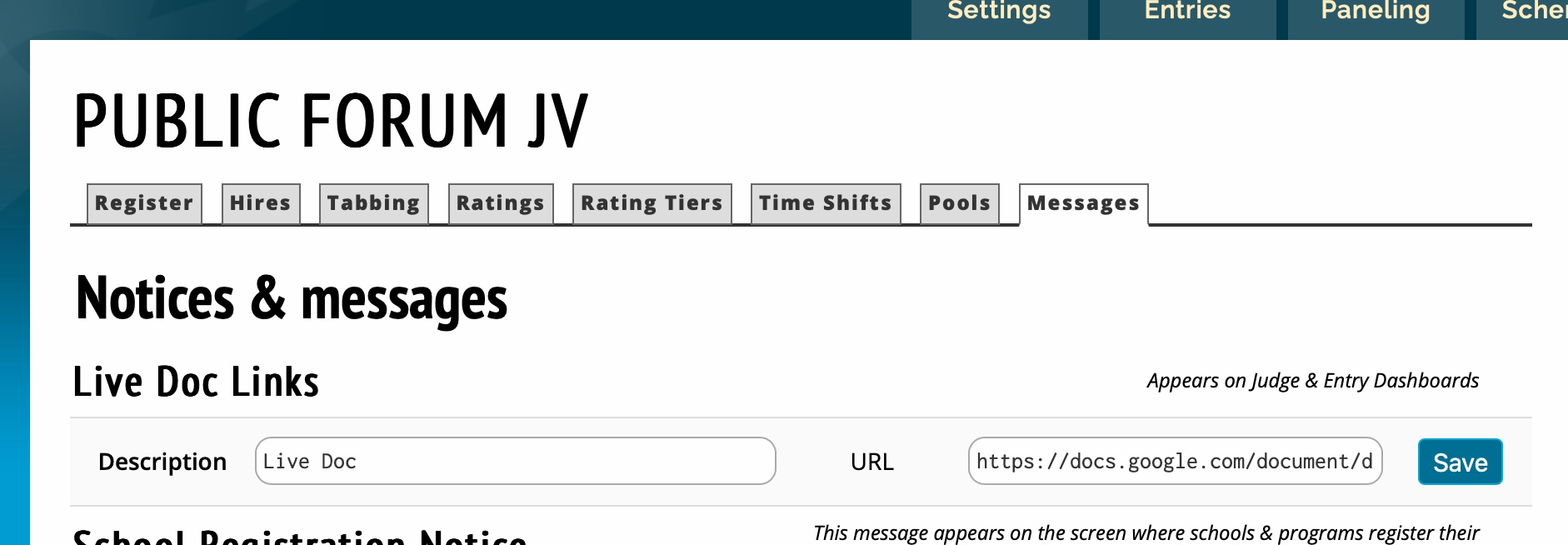
Our practice has been to create the Live Doc as a Google Doc, allowing key tournament staffers access for editing in advance and updating during the tournament. We usually send out the read-only link a few days prior to the tournament. Too soon is too soon, and too late is too late; Wednesday before a Friday start seems about right. We send it to the coaches requesting that they share the link with their students, and we send it directly to the judges. There is now a spot for it in tabroom.com under Settings/Judges/Messages:
E-Tournaments
- Complete Guide to Running an E-Tournament The 2025 guide to virtual tournaments.
- E-Ballot instructions. Using e-ballots and want to make sure your judges are plugged into tabroom.com? Take this general file and distribute it directly to the judges or link to it in your Live Doc. It is probably a good idea to have a tech station set up somewhere for your judges to get connected throughout the tournament: often even the most constant of judges find they're no longer plugged into tabroom for some reason or other.
- How to be a Good E-Judge This humorous (?) albeit informative (?) document explains to the judges your expectations of them. Given how often judges don't do things correctly, even if they've been judging since the Pilgrims landed, it's probably a good idea to distribute it every time, or better yet, link to it in your Live Doc.
There have been those who have said that what they really want is a straightforward what-to-do, not a lot of silly jokes. Hence I've begun saying this in my brief opening remarks at tournaments, and adding a link to the rest of it in my email to judges.
Executive Summary
1. Get notification
2. Hit START button to acknowledge ballot.
3. Go to room
4. Enjoy round
5. Enter decision on device
6. Provide useful albeit pithy critique
Tournament Miscellany
- AI in Speech and Debate As a rule, we recommend banning use of AI during rounds at tournaments. The attached article explains all the reasons why in detail, but simply put, if debaters can access AI during their prep time, or if extempers can access AI in the prep room, all--and I mean ALL--the work is done for them.
- College Check List You're a student running a college tournament? Here's your vademecum. (I mean, you are in college, so no doubt you use the word vademecum every day.) This will also work for anyone else, more or less.
- Trophy Check List Use this to put in your trophy order. (A copy also exists as a
Google Sheet
, but I don't swear by that one.)
- How to Get Your Tabroom.com Assignments Instructions on setting up your tabroom account to send your assignments and tabroom emails directly to your account. This is incorporated into our general Live Doc, but you might want to send it out separately. As of this writing, 2025, this has not yet reached critical mass; I mean, people just aren't doing it. Go figure...
- Split Obligations If you're allowing coaches to split up their days among their judges, you might find that a lot of them just don't understand how to do it correctly on tabroom. Perhaps this short QuickTime video will help.
- Scheduling How much time is realistic? Make a good schedule that you can adhere to.
- There are plenty of ways to figure out how many teams are going to break at what level. For those who want a good old-fashioned Excel version, tarted up to make everything not only clear but recordable, download this baby: Pyramid. The Google sheets
version also works, but you have to make a copy of it first. (And honestly, given the choice between Excel and Sheets, is there really any choice at all?)
- Tab staff best practices Sure, tabroom.com makes it look easy. It isn't. Here are the rules of thumb for staffing your tab room.
- Emails If your tournament is large and complicated, you'll no doubt be emailing the registrants all sorts of things in advance. Here's how to manage emails so that they are reasonable in number, definitive in information, and most important, likely to be read.
- Comfort See to the comfort of your guests. Good hospitality is good manners, and good business.
- The Concierge Table The ballot table is dead. Long live the Concierge Table!!! This is either the hub of the tournament, or it's where your students with nothing better to do make it impossible for your guests to get information. Which sounds better to you?
- Round Robins There's a couple of things you need to think about, and a tip or two, if you go the RR route.
- Novice (and JV) Divisions What, exactly, is a novice? Definitions vary, but if your tournament isn't rigidly specific, you're asking for trouble.
- The Needham Protocol
Sometimes at local events judges have to judge their own school. When this is unavoidable, we invoke the Needham Protocol. This short document will help guide the judges (usually HS students) through the situation.
- Guide to Tabroom.com This one is archival, so approach it accordingly. It is a fairly exhaustive guide to how tabroom.com's software works, beyond the helps available in the program. It was written at the time when a few of us had used tabroom a lot, but to most people it was completely new. It is available both as a pdf of the entire guide, and a webpage breaking it down into smaller bite-sized pieces. Since this was written, tabroom has vastly improved its help screens, and has added or improved many of its features, including virtuality, but most of the guide is still accurate enough, at least as a starting point for tabroom.com noobs.
|